

Knowing your exact lawn area is the foundation of every smart lawn care decision — from buying the right amount of grass seed and fertilizer to choosing a sprinkler system that covers your yard without waste. This lawn area calculator handles the four most common lawn shapes (rectangle, circle, triangle, and L-shape) and instantly converts your result into square feet, square meters, and acres, so whether you work in imperial or metric units you always get a number you can use right away.
Lawn Area Calculator: Instant Square Footage and Metric Results
Calculate your lawn area in square feet, square meters, or acres for any shape — rectangle, circle, triangle, or L-shape — to plan seeding, fertilizing, and watering.
How to Use This Calculator

Follow these steps to get an accurate lawn area measurement:
- Choose your lawn shape from the drop-down menu. If your lawn is irregular, break it into simpler sections and add the results together.
- Select your measurement unit — feet or meters — to match the tape measure or laser tool you used outside.
- Enter the dimensions that appear for your chosen shape. For a rectangle enter length and width; for a circle enter the radius; for a triangle enter base and height; for an L-shape enter all four required dimensions.
- Read your results instantly in square feet, square meters, and acres. Use these figures to calculate seed, fertilizer, or irrigation needs below.
Understanding the Calculator Inputs
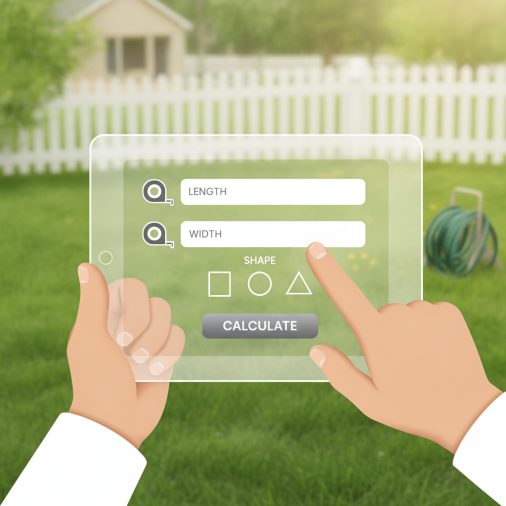
Lawn Shape: Select the option that best matches your lawn’s outline. A Rectangle / Square covers most standard suburban yards. Choose Circle for round ornamental lawns or island beds. Triangle works for corner lots or wedge-shaped sections. L-Shape is ideal for yards that wrap around a house corner — it treats the area as two separate rectangles joined together.
Measurement Unit: Choose Feet if you measured with a standard tape measure or a laser distance tool set to imperial. Choose Meters if you used a metric tape or obtained dimensions from a metric property survey. The calculator converts all outputs automatically, so you only need to enter numbers in one unit.
Length / Diameter / Base (A): For a rectangle this is the longer side. For a circle, enter the full diameter (the distance straight across the widest point) — the calculator halves it to find the radius internally. For a triangle, enter the base. For an L-shape, enter the length of the first (larger) rectangle.
Width / Height (B): For a rectangle this is the shorter side. For a circle this field is not used in the calculation but you may leave it at any value. For a triangle, enter the perpendicular height (not the slant side). For an L-shape, enter the width of the first rectangle.
L-Shape Second Rectangle Length (C) and Width (D): These fields are only relevant when you select the L-Shape option. Measure the second arm of the L separately and enter its length and width here. Make sure you do not double-count the corner area that belongs to both rectangles — measure each arm up to where they meet.
Understanding Your Results
Lawn Area (sq ft): The primary output used by most North American product labels. Grass seed bags, fertilizer spreaders, and weed-control products all list coverage in square feet, so this number is your go-to figure for shopping.
Lawn Area (sq meters): Useful for gardeners in metric countries or when working with irrigation equipment rated in m². One square meter equals approximately 10.764 square feet.
Lawn Area (acres): Helpful for larger properties. One acre equals 43,560 square feet. If your result is close to 1 acre, you may want to explore sprinklers designed for 1-acre lawn coverage to ensure efficient irrigation.
Recommended Grass Seed (lbs): Calculated at the standard new-lawn seeding rate of 5 lb per 1,000 sq ft. This is a general guideline; the actual rate varies by grass species (see common mistakes section). Always check the bag label for the species-specific rate.
Recommended Fertilizer (lbs N): Based on the widely accepted guideline of 1 lb of actual nitrogen per 1,000 sq ft per application. This is the weight of nitrogen, not the total bag weight. Divide by the nitrogen percentage on the bag label (e.g., a 30-0-4 fertilizer is 30% N, so divide lbs N by 0.30 to get total bag weight needed).
Estimated Weekly Water Need (gallons): Most established cool- and warm-season grasses need about 1 inch of water per week. One inch of water over 1 square foot equals 0.6233 gallons. This estimate does not account for rainfall, soil type, or evapotranspiration — treat it as a planning baseline. For large lawns, choosing the best sprinkler for large area coverage can help you hit this target efficiently.
Calculation Formulas Explained
Rectangle area: Length × Width. This is the simplest and most common formula. A 40 ft × 25 ft lawn gives 1,000 sq ft.
Circle area: π × r², where r is the radius (half the diameter). The calculator uses π = 3.14159265 and computes r = diameter ÷ 2 internally, so you only need to enter the diameter.
Triangle area: 0.5 × Base × Height. The height must be the perpendicular (right-angle) height, not the length of a slanted side.
L-Shape area: (Length1 × Width1) + (Length2 × Width2). The L-shape is split into two non-overlapping rectangles and their areas are summed.
Unit conversion factor: When you select Meters, the field values are in meters. The calculator multiplies the raw area (in m²) by 10.7639 to convert to sq ft, then divides back as needed for the m² result. This keeps all formulas consistent regardless of input unit.
Grass seed estimate: Area (sq ft) ÷ 1,000 × 5 lb. The 5 lb/1,000 sq ft rate is a mid-range figure for common cool-season grasses such as tall fescue and Kentucky bluegrass seeded from scratch.
Fertilizer estimate: Area (sq ft) ÷ 1,000 × 1 lb N. This gives pounds of pure nitrogen, which you then convert to bag weight using the product’s guaranteed analysis label.
Water estimate: Area (sq ft) × 0.6233 gal. This constant comes from the fact that 1 inch of water over 1 sq ft = 1/12 ft³ = 0.08333 ft³, and 1 ft³ = 7.48052 gal, so 0.08333 × 7.48052 ≈ 0.6233 gal/sq ft/inch.
Worked Example
Scenario: You have an L-shaped backyard. The main section measures 45 ft long × 30 ft wide. The side wing measures 20 ft long × 15 ft wide. You want to reseed the entire area and set up a weekly watering schedule.
- Select L-Shape from the Lawn Shape menu.
- Select Feet as the measurement unit.
- Enter Length A = 45, Width B = 30, Length C = 20, Width D = 15.
- The calculator computes: (45 × 30) + (20 × 15) = 1,350 + 300 = 1,650 sq ft.
- In square meters: 1,650 ÷ 10.7639 ≈ 153.3 m².
- In acres: 1,650 ÷ 43,560 ≈ 0.03788 acres.
- Grass seed needed: 1,650 ÷ 1,000 × 5 = 8.3 lbs. Buy two 5-lb bags to have a small buffer.
- Fertilizer nitrogen needed: 1,650 ÷ 1,000 × 1 = 1.65 lbs N. If using a 28-0-3 fertilizer (28% N), you need 1.65 ÷ 0.28 ≈ 5.9 lbs of product.
- Weekly water need: 1,650 × 0.6233 ≈ 1,028 gallons per week assuming no rainfall.
How to Interpret the Results
Once you have your square footage, compare it against product label coverage rates before purchasing. A result under 500 sq ft is a small patch where a single bag of seed or a handheld spreader is usually sufficient. Areas between 500 and 5,000 sq ft represent typical suburban lawns where standard consumer products are sized appropriately. Lawns over 5,000 sq ft may benefit from bulk purchasing and a broadcast spreader. Anything approaching or exceeding 43,560 sq ft (1 acre) moves into semi-commercial territory where professional-grade equipment and bulk materials become cost-effective.
For the water estimate, compare the gallons figure against your sprinkler’s output rating (usually listed in gallons per hour or gallons per minute) to calculate how long to run each zone. If your weekly water need is 1,000 gallons and your sprinkler outputs 3 gallons per minute, you need roughly 333 minutes of run time spread across the week — about 47 minutes per day. Heavy clay soils may need shorter, more frequent cycles to prevent runoff, while sandy soils drain quickly and may need more frequent watering.
Common Mistakes to Avoid
- Measuring the whole property, not just the grass: Driveways, patios, garden beds, and structures are not lawn. Walk the perimeter of the grass only and exclude hardscape areas.
- Using slant height for triangles: The triangle formula requires the perpendicular height — the straight-up distance from the base to the opposite corner. Using the slant side will overestimate area.
- Entering radius instead of diameter for circles: This calculator asks for the full diameter. Entering the radius will cause the formula to use half the radius, giving an area four times smaller than reality.
- Double-counting the L-shape corner: When measuring the two arms of an L-shaped lawn, stop each measurement at the inner corner. If you extend both measurements through the corner, you count that square twice.
- Applying the wrong seeding rate: The 5 lb/1,000 sq ft default is for new lawns with cool-season grasses. Bermuda grass is typically seeded at 1–2 lb/1,000 sq ft; zoysia at 1–3 lb/1,000 sq ft. Always verify the rate on your specific seed bag.
- Ignoring rainfall in the water estimate: The weekly water figure assumes zero rainfall. Subtract any rainfall received that week from the irrigation target to avoid overwatering and fungal disease.
Limitations and Important Notes
This calculator assumes simple geometric shapes. Real lawns are rarely perfect rectangles or circles; for highly irregular shapes, divide the lawn into multiple sections, calculate each separately, and add the results. The grass seed and fertilizer estimates are planning guides based on industry-average rates and do not replace the specific instructions on product labels, which vary by species, formulation, and local conditions. The water estimate uses a flat 1 inch per week guideline and does not account for local evapotranspiration rates, soil water-holding capacity, slope, shade, or current weather — consult your local cooperative extension service for region-specific irrigation schedules. Fertilizer calculations give pounds of elemental nitrogen only; always follow soil test recommendations and local regulations regarding nutrient application near waterways. This tool is intended for planning purposes only and does not constitute professional agronomic or landscaping advice.
Frequently Asked Questions
How do I measure my lawn if it has an irregular shape?
The easiest approach is to divide the irregular lawn into several overlapping simple shapes — rectangles, triangles, or partial circles — that together cover the whole area. Calculate each section separately using this calculator, then add all the results together. For very complex shapes, you can also use a free satellite mapping tool (such as Google Earth’s measurement feature) to trace the lawn boundary and read off the area directly, then use this calculator to cross-check and plan product quantities.
What is the difference between lawn area and lot area?
Lot area is the total size of your property as recorded in the deed or tax records, including the house footprint, driveway, sidewalks, garden beds, and any other structures. Lawn area is only the portion covered by grass. For most suburban homes, the lawn area is 40–70% of the total lot area once you subtract the house, hardscape, and planted beds. Always measure the grass-only area when buying lawn care products, because applying seed or fertilizer to driveways or patios wastes money and can cause environmental runoff.
How accurate is the circle formula when I enter the diameter?
The formula π × (diameter ÷ 2)² is mathematically exact for a perfect circle. In practice, most round or oval lawns are not perfect circles, so the result is an approximation. For an oval (ellipse), a better formula is π × (half-length) × (half-width), which you can approximate by entering the long axis as Length A and the short axis as Width B using the Rectangle option and then multiplying the result by π ÷ 4 (approximately 0.7854) — though this level of precision is rarely needed for lawn care planning.
How many square feet is a typical residential lawn?
According to U.S. housing data, the median lot size for a new single-family home is around 8,000–9,000 sq ft, but the actual lawn area after subtracting the house, driveway, and landscaping beds is typically 2,000–5,000 sq ft for a suburban home. Smaller urban lots may have lawns under 1,000 sq ft, while rural properties can exceed an acre. Knowing your specific number matters because product coverage rates vary widely — a bag rated for 5,000 sq ft will be far too much for a 1,200 sq ft lawn and not enough for a 7,000 sq ft one.
Can I use this calculator to plan a sprinkler system?
Yes — the square footage and weekly water need outputs give you a solid starting point. Divide your lawn into irrigation zones based on sun exposure, slope, and grass type, then size each sprinkler head or rotor to cover its zone. The weekly gallons figure helps you verify that your water supply (well pump capacity or municipal meter size) can deliver enough water. For large properties, heavy-duty lawn sprinklers built for high output are worth considering to cover the area within a reasonable run time.
How do I convert my lawn area from square feet to square yards for carpet or sod pricing?
Divide the square footage by 9, because one square yard equals 9 square feet. For example, a 2,700 sq ft lawn equals 300 square yards. Sod is sometimes sold by the square yard, pallet (which typically covers 450–500 sq ft), or roll, so confirm the unit with your supplier before ordering. The square meter result shown by this calculator is also useful if your sod supplier quotes metric prices.
Does the fertilizer estimate account for slow-release versus quick-release products?
No — the calculator outputs only the total pounds of elemental nitrogen (N) needed based on the standard 1 lb N per 1,000 sq ft guideline. Whether you use a slow-release, quick-release, or organic fertilizer does not change the total nitrogen target, but it does affect how often you apply it. Slow-release products feed over 8–12 weeks, so one application may cover a full season. Quick-release products act within days but may need reapplication every 4–6 weeks. Always read the product label for application frequency and never exceed the maximum annual nitrogen rate recommended for your grass species.
How do I measure a sloped lawn — do I use the ground distance or the slope distance?
For lawn care purposes such as seeding, fertilizing, and watering, use the horizontal ground distance (the flat map distance), not the slope distance measured along the hill. This is because product coverage rates are based on the horizontal area that receives the product, not the surface area of the slope. If you measure along the slope with a tape measure, you will slightly overestimate the area. For very steep slopes (over 30°), the difference becomes meaningful — in that case, multiply your slope measurement by the cosine of the slope angle to get the true horizontal distance.
